
You Have Three Layers of Mind. You're Only Using One.
And the one you're ignoring is the only one that's infinite.

Your mind has three operating layers.
Modern life has been systematically strip-mining the deepest one since you were twelve.
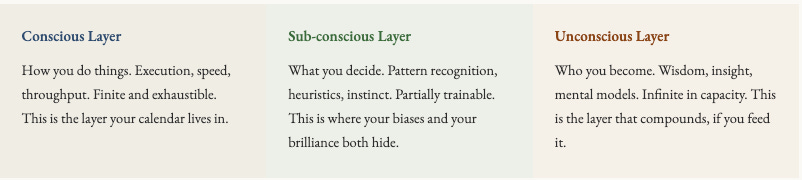
Proven across neuroscience, psychology, and ancient philosophy, the mind is mapped in three bands. The conscious layer: the short-term, task-oriented surface where most of your workday lives. The sub-conscious: the medium-term pattern library that shapes what you decide without your knowing it. And beneath both vast, quiet, and almost entirely untapped the unconscious: your accumulated mental model of reality, the seat of wisdom, the layer that, unlike the other two, has no ceiling.
Here is what nobody told you when you became a founder, or made Managing Director, or took the board seat: you have been rewarded, your entire professional life, for optimizing the wrong layer.
"The conscious mind is finite. It runs out.
The unconscious is infinite. We treat it like a basement
we keep meaning to clean but never do."
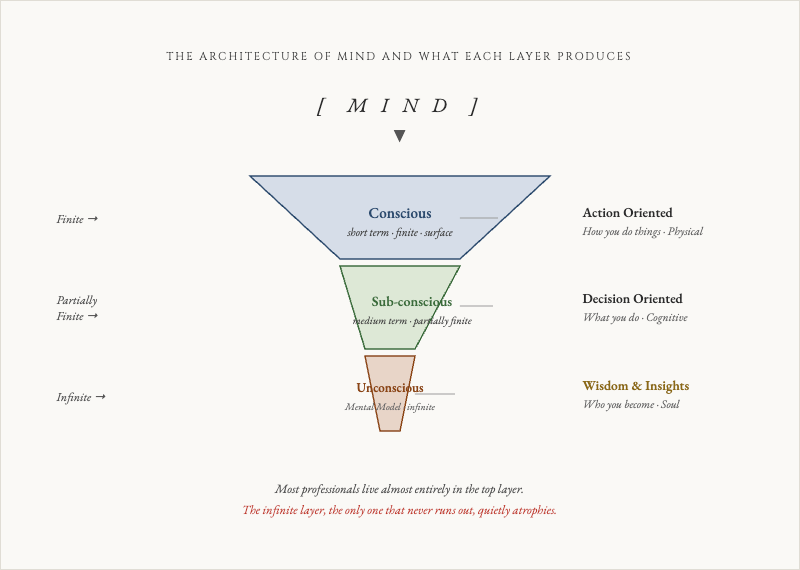
Look at the triangle from my earlier above. At birth, the deepest layer is widest. Children operate from instinct, wonder, and an almost primal connection to pattern and meaning. Then school trains them out of it. Career finishes the job. By the time most executives hit their peak earning years, they are running almost entirely on conscious bandwidth packed calendars, dopamine-loop dashboards, the tyranny of the urgent with the sub-conscious running on decade-old patterns, and the unconscious layer barely touched.
We call this high performance. We should call it what it is: a slow amputation of our deepest cognitive resource.
The Data Makes It Worse
Neuroscientist Antonio Damasio demonstrated that the unconscious processes roughly 11 million bits of information per second. The conscious mind handles about 40 bits. You are running your company, your investments, your relationships almost entirely on the 40-bit layer. The 11-million-bit engine is idling.
Harvard’s Robert Kegan found that fewer than 20% of adults ever develop what he calls a “self-authoring mind” the capacity to examine your own mental models, hold contradiction, and think beyond the frameworks others handed you. The other 80% are making high-stakes decisions from a sub-conscious layer they have never once audited.
And wisdom? The average age at which leaders describe accessing genuine insight, not knowledge, not experience, but synthesized wisdom, is their late 50s. By which point most of their highest-leverage decisions are behind them.
Look around at the ones who made it. Really made it, by every external measure. The exit, the title, the wealth, the recognition. From the outside, the story is clean. From the inside, ask what it cost. Ask their spouse. Ask their body. Ask the friendships that quietly dissolved, the health that was quietly mortgaged, the version of themselves they quietly stopped being somewhere around year four of the sprint that never ended. Something always gives. It just gives on the inside first, where nobody can see it, until one day it becomes visible, and by then the bill is very large.
That is the provocation. Not that ambition is wrong. Not that the drive to build and achieve is misguided. But that running at full velocity on the first two layers, indefinitely, without ever pausing to go deeper, is a bet you are making with someone else's chips. Your health. Your relationships. Your interior life. The people closest to you absorb what the mission produces but cannot yet account for.
The founders who build enduring companies aren't the ones with the best processes. They are the ones who metabolize failure slowly, read widely, sit with discomfort, and develop a mental model of reality that is richer, more accurate, and more adaptive than their competitors'. That is a wisdom advantage. It compounds, like interest, in the background, while everyone else is optimizing their inbox.
"Action without wisdom is just expensive noise.
Decisions without wisdom are just faster mistakes.
Wisdom without action is poetry.
All three together that is what mastery looks like.”
The third layer is where you calibrate. Not once, at the end, when the dust settles and you finally have time to reflect. But repeatedly, along the way. Is this still worth it? Is who I am becoming someone I would choose? Are the things I am accumulating on the outside matched by something growing on the inside? These are not soft questions. They are the hardest questions. And they can only be answered from the deepest layer.
The layer that never runs out is the one you keep putting off. But the price of putting it off is not paid by you alone. When did you last deliberately feed it?
The layer that never runs out
is the one you keep putting off.
When did you last deliberately feed it?