

What is the one thing that consistently defines every high-performing team in the world?
Over the years, we’ve all admired teams whether in sports or in business and wondered what truly sets them apart. Most people will cite talent, teamwork, trust, hard work, execution, confidence, vision, or focus. And they’re not wrong. All of these matter.
But in my experience, they are visible outcomes, not the underlying cause.
There is a deeper element that consistently separates great teams from merely good ones.
It isn’t something you can buy, hire, or manufacture overnight. It takes time, pressure, and deliberate forging.
That element is character.
Not as a single trait, but as a composite force.
In 2013, as I took over a team of 6,000 associates, I was given the mandate to rapidly scale the delivery center and bring renewed energy and edge to what was the most visited Accenture site in Bangalore. I began with a small leadership team of four senior executives each with far deeper experience in the business than I had while I was coming in from the U.S. with a technology background.
The first 9–12 months were hard lessons. I struggled to truly take the reins and unify a team operating across more than five locations and seven distinct capabilities. Over time, that experience became my crucible. We rotated some leaders, expanded the leadership team to more than 20, and eventually scaled the organization to nearly 25,000 associates. Along the way, we emerged as leaders in automation and became one of the firm’s strongest showcases of delivery excellence.
Through that journey, I came to deeply understand the importance of forging a team rooted in character. On the surface, many of our successful leaders who traversed this journey, initially were seen as misfits or stagnant. Yet this very team surprised everyone delivering remarkable growth year after year. The deepest value they consistently demonstrated was character.
Character is often described as a distinguishing attribute or the set of mental and ethical traits that shape individuals and groups. But when I speak of character, I mean something far deeper.
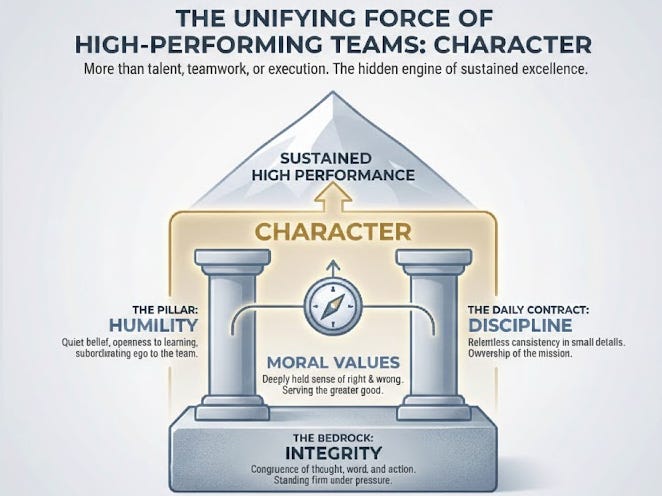
Character is the ability to commit to a purpose larger than oneself with discipline and humility while staying aligned to strong moral values.
Every truly high-performing team from the New Zealand All Blacks, Apple under Steve Jobs, Real Madrid, the San Antonio Spurs, Coca-Cola under Roberto Goizueta, the New England Patriots, Mercedes F1 has demonstrated this consistently.
Character begins at the individual level and, over time, synthesizes at the team level. When it is woven deeply across a group, it produces sustained excellence. When it erodes, performance collapses often far faster than anyone expects.
Character enables world-class performance, but it is not permanent. It must be continually reinforced. When its underlying elements degrade, even great teams can fail or stagnate sometimes with only a few changes because what they lose isn’t talent or strategy, but character itself.
True character is not a single trait. It is a convergence of multiple attributes that reinforce one another.
Integrity: The Bedrock
Every individual in a high-performing team operates with a deep sense of integrity : congruence between thought, word, and action.
These are people who stand for something internally. Often shaped by environments that demanded high ethical standards, they develop a core that does not waver under pressure. You may not always agree with their style or approach, but they are consistent every single time.
Individuals with high integrity make personal sacrifices for the larger purpose almost instinctively.
Warren Buffet captured this perfectly
“In looking for people to hire, you look for three qualities: integrity, intelligence, and energy. And if they don’t have the first, the other two will kill you.”
Integrity is the bedrock. Without it, you can never build a high-performing team. When things inevitably go wrong and they always do, integrity is what reassures each member that their peers will stand firm and true.
Humility: The Pillar
Each high performing individual carries a quiet humility and often, faith.
Call it belief in a higher power, faith, luck, or simply acceptance of forces beyond our control. They understand that in the vastness of the universe, none of us are as important as we think and that outcomes often require more than individual brilliance.
This humility is what keeps them open to learning. It allows confident people even those who may appear arrogant to adapt rapidly, accept feedback, and subordinate ego to the team’s playbook.
Even Steve Jobs acknowledged that
“It doesn’t make sense to hire smart people and then tell them what to do; we hire smart people so they can tell us what to do.”
Humility makes teams self-correcting. It allows them to give and receive feedback, to acknowledge others in victory, and to show grace in defeat. It reminds them that they stand on the shoulders of many.
If integrity is the bedrock, humility is the pillar. Remove it, and sooner or later, the structure collapses.
Discipline: The Daily Contract
High-performing teams are built by individuals who embody discipline not in grand gestures, but in daily behavior.
Kobe Bryant arrived at practice hours before his teammates, every day, for years. That relentless repetition earned him the reputation of the greatest tough-shot maker not because of talent alone, but because of discipline.
Discipline comes from a deep sense of responsibility to oneself and to others. It is ownership of the mission beyond immediate tasks. Discipline is not about talking about big games. It is about doing small things, consistently, over long periods allowing compounding to work its magic.
Muhammad Ali said it plainly:
“The fight is won or lost far away from witnesses… long before I dance under those lights.”
John Wooden famously taught players how to put on their socks properly to avoid wrinkles, blisters, lost practice time, and ultimately lost games.
Those socks were never about socks.
They were about understanding that small details ignored today become big problems tomorrow.
Moral Values: The Compass
Every member of a high-performing team carries deeply held moral values and a clear sense of right and wrong.
These values are forged over time and reflect an intent to do good, stay good, and leave things better than they found them. They do not weaken under pressure, they become more visible.
In a world where leadership often bends with the wind, it’s tempting to believe values no longer matter. My experience says otherwise. I encounter people with strong moral cores constantly.
We are built to serve. We thrive when we give. That instinct is the foundation of values.
Values are what make a player pass the ball instead of chasing personal glory. They are what make leaders credit the unseen contributors the water boys, the groundskeepers, the support staff.
As Muhammad Ali said in his most tough times
“I know where I’m going and I know the truth. I just can’t compromise my principles for a fight or for fame.”
Values provide oxygen in the hardest moments. They keep teams climbing when conditions are hostile.
Reed Hastings, Netflix Founder said it powerfully:
“The real test of our values is what we do when it costs us something.”
Character Under Pressure
Character is easy to admire when incentives are aligned and outcomes are favorable. It becomes decisive when they are not. In every large system I’ve been part of, the real test of character surfaced when performance pressures, revenue targets, or short-term wins tempted compromise. The strongest teams did not rely on goodwill or personal virtue alone they designed leadership standards, decision norms, and accountability mechanisms that made character non-negotiable, even when it came at a cost. In the short term, that discipline was uncomfortable. In the long term, it was precisely what sustained trust, execution quality, and performance when others faltered.
Character Is Non-Negotiable
Can you build character with only two or three of these attributes?
The answer is no.
Integrity as the bedrock, supported by humility, discipline, and moral values, is an interdependent system. Remove one, and the others begin to decay rapidly.
As John Wooden said:
“Ability may get you to the top, but it takes character to keep you there.”
So if you want to build a high performing team make sure each one of your team member embodies these attributes - Integrity, Humility, Discipline and Values - Character”
Now if you have read till here, congrats, you are already a stellar leader or an aspiring young leader about to change the world around her or him. The bigger question is how do you build character for an individual and a team? Is it preordained how people are ? Can Character be built?
These are seminal questions as you think about your team and it’s evolution. The simple answer is some of the elements have to be pre installed in the individuals whereas some can be forged and built. Even if some attributes are lighter than others, they MUST be strengthened to reach a degree of high performance.
So I’ll leave you with a simple question:
Does your team have character?
P.S. How do you test and build character? That’s for another article.
Download The Character OS Playbook here