
We Replaced Leaders With Performers
A quiet crisis of meaning inside the world’s most powerful companies, as builders give way to performers.

“Can you name one US Public company CEO you can follow into a storm?”
I can’t either and it’s quite disappointing and frustrating. Yes there are many who are extolled for their stock performance or monopolistic hold on certain segments but not one who is capable of inspiring us to be them!
We are surrounded by CEOs but starved for leaders.
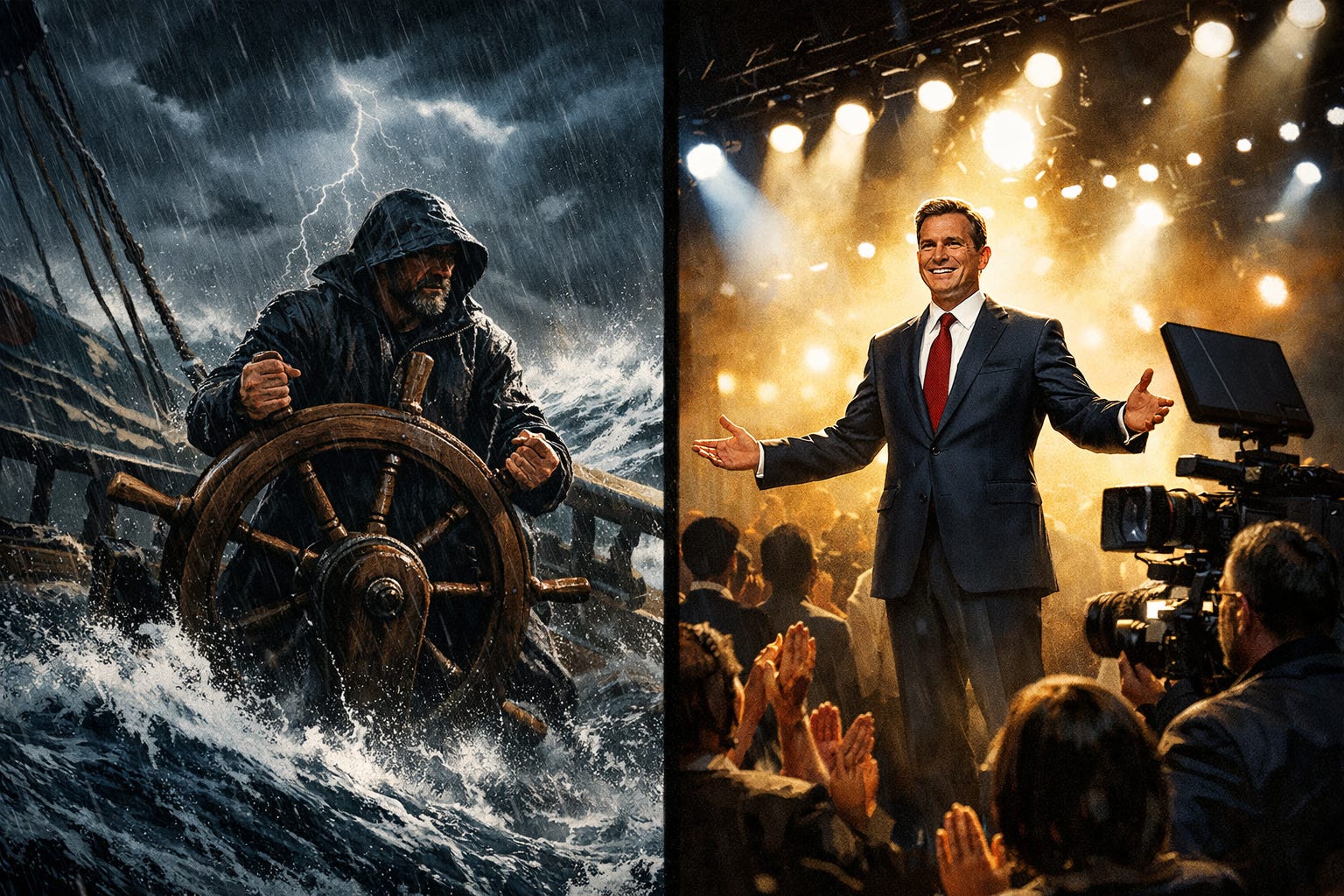
In the early 1990s and 2000s we debated leaders because they stood for things. You could love or hate Steve Jobs, Alan Mullaly, Anne Roddick, Anne Mulcahy, A G Lafley and more but you could not ignore them. They were flawed human beings in their own ways but when you totaled their “Human Balancesheet” we all wanted to be them. Because they took positions on what they believed was right. They stood for something larger than just their companies’ stock performance, profits or public image.
Today’s corporate leaders are different. They are highly intelligent, deeply competent and exquisitely careful. They do not put a stake in the ground on values. They hedge, they derisk and optimize.
This is not because today’s executives are worse people. It is because they operate inside a system that quietly punishes anyone who dares to stand for something bigger than the stock price.
And that is why so many people — employees, founders, even investors — feel like they are still searching… for real leadership.
Why did we lose the leadership ethos?
Financialization ate leadership: In 1980, 10% of S&P Profits went to shareholders and today about 90% of profits go to shareholders via buybacks and dividends. That means CEOs became portfolio managers and not institution builders.
Board Compensation Trap: Board members make $300K-$500K and sit across multiple boards so they are not focused on legacy, employees, innovation or larger mission. They optimize for stock stability.
Professional CEOs: Over the last decade or so we saw a generational shift from Founder CEOs to Professional CEOs. Sundar Pichai, Satya Nadella, Tim Cook, all are brilliant operators but they did not found the company, they did not lose it all, they did not face bankruptcy. So when they face a values-based decision that conflicts with financial/shareholder outcomes, they flinch. Not because they are weak but because they have never bled for the company.
CEO Tenure collapse: And they flinch because average CEO tenure has gone from 9-10 years in 1995 to 5 years or less today. You cannot build moral authority in 5 years; you can only manage optics and finances.
The Pay-Ratio Explosion: In 1965, the CEO-to-worker pay ratio was 21:1. By 2020, it hit 351:1. When a CEO is paid 300x their average worker, their “tribe” is no longer their employees—it is the top 0.1% of the financial elite.
Reputation Risk: Every decision and move is litigated on Twitter(X), every move is weaponized in a highly tribal world, and creates political theater. So leaders have become PR- managed, not principle driven.
We didn’t lose great leaders. We built a system that no longer allows them to exist.
So the key question is will this ever turn around and if yes, when?
Yes, it will - not because people suddenly will become better, but it will flip because the system will break.
The revival will come when the following axes converge and combined with a declining market performance will drive a change. And you can sense it today in some ways.
The Human Angle: Employee Fatigue as the Spark for Bottom-Up Change
While 80% of workers report finding some meaning in their jobs, 35% are still considering leaving, highlighting a “meaning paradox” where surface satisfaction masks deeper voids. The pandemic eroded employer-employee bonds, with 23% of workers feeling less loyal due to mishandled responses. By 2026, 73% of HR leaders report employee “change fatigue,” with execution suffering as workers feel overwhelmed. Burnout affects 83% of employees, exacerbated by grind culture and inflexibility
As financial security grows (e.g., via remote work gains), the human need for purpose intensifies—COVID accelerated this, diluting blind loyalty and setting the stage for bottom-up demands like meaningful roles over optimization.
The AI Existential Threat: Accelerating the Turning Point
AI poses an “existential threat” to employees, with professional managers optimizing humans as AI adjuncts. This could be the catalyst: As white-collar jobs face displacement, workers will demand values-based leaders who prioritize human dignity over efficiency. AI isn’t yet mass-displacing but is reshaping white-collar roles (e.g., finance, tech, law), with exposed jobs growing faster than average. Projections for 2026 show 11 million new AI-related jobs but significant risks, requiring constant upskilling. In 2–3 years, as AI matures (e.g., better tools by 2028), managers’ optimization focus will clash with employee demands for meaning—sparking values revival or mass unrest.
AI is amplifying optimization, not leadership.
Radical Transparency & the Glass Box Organization
In the 90s, a CEO’s lack of values could be hidden behind PR. Today, internal Slack channels and Leaked Memos have turned companies into glass boxes. Strategic Blandness is becoming a liability. Employees (especially Gen Z) are increasingly willing to leave high-paying roles for Values Alignment. The War for Talent will eventually force CEOs to take a stand just to keep their best talent.
Inspiring Values based Leadership is coming
When enough people start looking for meaning again, real leaders will appear. This cycle repeats itself every 20 years or so. And we are 15 years into the erosion of values based leadership. As someone said, History does not repeat but rhymes. We saw similar revival periods post the Great depression into the FDR era, Post the Vietnam war to the 70s-80s reformist period and post Enron, Dot Com to early 2000s.
We are currently in the Trough of Disillusionment, where the lack of leadership is most painful.The political theater globally also adds this to disappointment at scale. The Stewardship era was fueled by cheap money (Zero Interest Rate Policy). When money is free, you don’t need values; you just need growth.Only leaders with a Moral North Star can keep a team together when the stock is down 50%.
The stewardship model—often characterized by risk-aversion and a focus on incremental quarterly growth—is increasingly being challenged by a more “agentic” or “founder mode” style of leadership. This shift is led by individuals who prioritize deep conviction, long-term vision, and a willingness to walk through “storms” to protect the soul of their company.
And the tide is turning. I see the new incumbent leaders starting to emerge.
Emerging Founder-Leaders: Role Models Challenging Incumbents
New entrepreneurs like Charles Prince of Cloudflare, Brian Chesky of Airbnb, Tobi Lutke of Shopify must scale to demonstrate values-based success, inspiring others. They’re not yet at “incumbent” size but are gaining traction, showing how founder grit can infuse purpose.
These leaders embody “chutzpah” from building through storms (e.g., Chesky’s COVID pivot), but need to hit trillion-dollar scales to fully role-model against incumbents. In a few years, as they grow, they could inspire a wave of founder-challengers.
In an age where AI can optimize a spreadsheet better than any human manager, the only remaining unfair advantage is the human heart—the Chutzpah to stand for something when the wind blows the wrong way, and the Moral Authority that only comes from having walked through the storm.
So it begs a question, what does each one of us do till the tide turns?
Everyday Preparation: How to Build Your “Internal Chutzpah”
We cannot wait for the Boards to change; we must change the culture from the inside out.
Practice “Micro-Chutzpah”: Don’t wait for a storm to stand for something. Practice stating a value-based opinion in a meeting where it’s easier to be silent.
Build your “Trust Battery”: Tobi Lütke’s (Shopify) concept. Every interaction either charges or drains the trust people have in your word. A “Humane Leader” has a battery that is always at 100% because they don’t play political games.
The “Wait for the Details” Rule: Like Brian Chesky, refuse to be “high level.” Leadership is the intersection of grand vision and the smallest pixel. If you don’t care about the details, you don’t care about the value.
Audit your Incentives: Personally ask yourself: “Am I doing this because it’s right, or because my personal ‘payout curve’ tells me to?” If you can’t tell the difference, you’ve already become a steward.
The next generation of leaders will not be appointed. They will be followed. Not because they manage better, but because they risk more. Not because they say the right things, but because they are willing to lose something for what they believe.
And when enough people are ready to follow again, real leadership will return, not as a trend, not as a title, but as a necessity.
We have spent a decade treating leadership like a science of mitigation rather than an art of conviction. We have built safe boardrooms and polished C-suites, only to find that in our quest to eliminate risk, we accidentally eliminated soul.
But the Stewardship Era is hitting its expiration date. The search for humane leadership doesn’t end with a headhunter or a better compensation formula. It ends when we stop asking “Who will lead us?” and start asking “What do I stand for?”
The era of the Builder—the leader who cares more about the pixels and the people than the payout—is returning.
Don’t just search for that leader. Be the storm that brings them back.