


I got home late one night from a dinner with friends that had turned into a three-hour debate about AI. A friend eventually proclaimed something like, “Our kids are graduating into a world where their jobs won’t exist.” Existential stuff. Real anxiety. These aren’t uninformed people, they’re founders, executives, parents and the fear in that room was palpable.
The next morning, I woke up, opened my phone, and counted 16 announcements of AI companies raising capital. Hundreds of millions of dollars, cumulatively. I’ve been seeing 10 to 15 of these announcements every single day for months now. The money pouring in is staggering.
But here’s what keeps nagging at me: when I talk to CIOs and CTOs inside actual enterprises, the people who run production systems at scale, the real deployments of AI are still very minimal. Pilots, yes. Experiments, plenty. But production-grade, revenue-impacting, workforce-transforming AI? We’re barely scratching the surface.
So I’m sitting there with my morning chai, caught between last night’s existential dread and this morning’s funding euphoria, and I realize I’m confused. Not about AI’s potential. I’m confused about the emotional whiplash. The wild swings between “AI will destroy everything” and “AI will save everything” that seem to happen in the span of a single news cycle.
I decided to take a step back and understand why the fear feels so much bigger than the reality on the ground.
We’ve navigated every major technological shift from the printing press to the internet. Fear first, adaptation eventually. Subliminally, everybody gets it. So why does AI feel so fundamentally different?
Because it is different, not in what it does, but in how we experience it.
Three forces are converging to make this moment unlike any previous technological shift.
The 3V Framework
Velocity. AI is evolving at a speed we’ve never seen with any prior technology. Every few months, something leapfrogs what came before. People feel the ground shifting constantly, even when their own job hasn’t been touched.
Visibility. This is the part that changes everything. AI can show you its output. It writes, draws, reasons, codes, right in front of your eyes. The steam engine was abstract. Electricity was invisible. AI is the first transformative technology that can demonstrate its capabilities to a non-technical person in real time. That visibility short-circuits the psychological buffer that previous technologies had. When disruption is abstract, you process it intellectually. When it’s visual and immediate, you process it emotionally.
Virality. Billions of people are connected online. The fear doesn’t drift like a ripple anymore. It crashes like a wave, uniformly, across geographies and industries, simultaneously. A single post about AI replacing jobs reaches 50+ million people in 24 hours.
Put these three together and you get a fear psychosis, a collective, emotionally-driven response to a threat that is real but temporally misplaced.
People are reacting to a 2030 reality as though it’s happening next Tuesday. AI, unlike any technology before it, makes the threat visible, personal, and immediate. And it plays directly into our fight-or-flight wiring.
The Decoupling Nobody Talks About
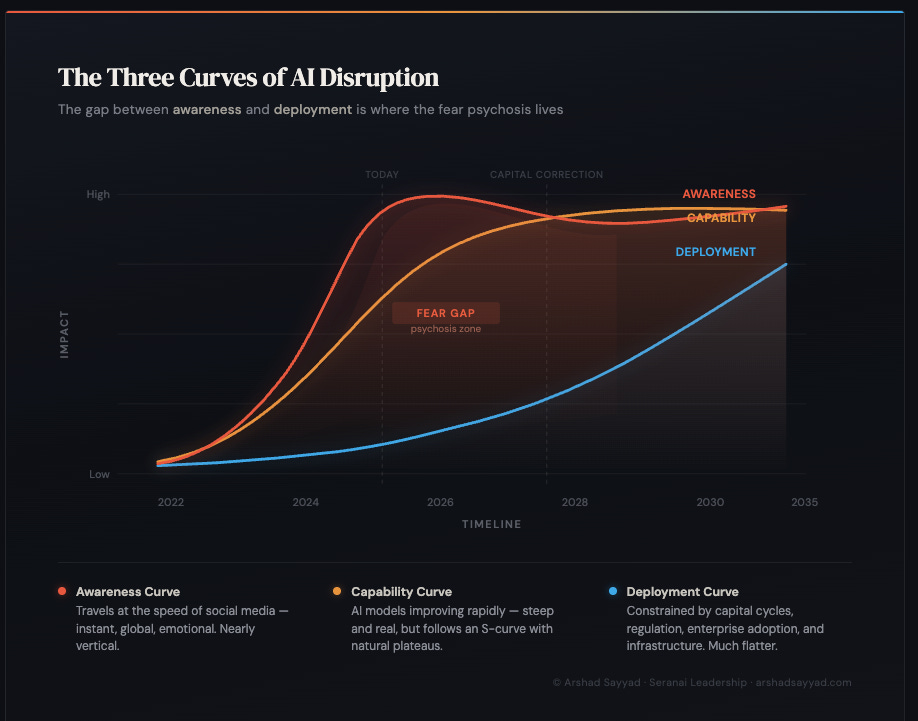
Here’s what nobody is paying attention to: there are three curves moving at very different speeds right now.
The Awareness Curve: nearly vertical. Everyone knows what AI can do.
The Capability Curve: steep and real, but following an S-curve with natural plateaus.
The Deployment Curve: much, much flatter. Enterprise adoption, regulatory friction, infrastructure buildout, procurement cycles all moving at the pace of institutional inertia, not Silicon Valley press releases.
The gap between awareness and deployment is where the psychosis lives.
It’s where fear gets amplified beyond what the ground reality warrants. And it creates a dangerous secondary effect: talent fleeing disciplines, policy overreactions, learned helplessness that actually slows productive adaptation. The fear becomes self-fulfilling.
Not because AI destroys jobs on schedule, but because the panic distorts decision-making at scale.
The Capital Constraint
And then there’s the capital reality everyone conveniently ignores. Hundreds of billions flowing into data centers, chips, power grids, model training. And the returns? Not remotely keeping pace. This is not sustainable indefinitely. At some point the investment cycle will correct, not because AI fails, but because returns have to catch up with capital deployment. It’s an inherently logical slowdown.
A metabolic regulation of the system will happen.
The industry will pull back, recalibrate, and grow sustainably. It always does.
The 80% Reality Check
There’s also a profound selection bias in the entire discourse. 80% of the world is still not affected by AI. The people most scared are the people most plugged into the awareness curve. And they’re writing the articles, making the videos, and feeding the cycle.
So here’s my honest advice: everybody needs to chill out and go for a walk. AI is not a meteor.
Think of AI more like getting a dog. It’ll change your routines, demand attention, make a mess sometimes, and occasionally do something that genuinely delights you. You’ll adjust. Life goes on, just a little differently.
But here’s what actually keeps me up at night.
The bigger question isn’t whether humanity adapts to AI. We will. We always do. The real question is: who gets to adapt?
AI is expensive. The infrastructure is expensive. The compute is expensive. And as AI compounds productivity gains for those who have access, what happens to those who don’t?
Does AI become the great equalizer? Or does it become the greatest amplifier of economic disparity in human history, where those who can afford it leap ahead exponentially, while those who can’t get left further and further behind?
We’re spending all our energy debating whether AI will take our jobs.
Maybe the more profound question is whether billions of people will ever be able to afford to use AI to better their lives in the first place.
And even if the benefits eventually trickle down to the masses and they will, slowly, gradually, the way electricity and the internet eventually did, the head start matters enormously. The people and companies who can harness AI today are compounding their advantages at an exponential rate. By the time access democratizes, the wealth concentration will have already hardened and concentrated even more than today.
The gap won’t just be wider. It will be massively structural.
That’s the disparity question. And it’s far more consequential than the disruption question.
You read this first on www.arshadsayyad.com
Arshad Sayyad is a technology executive, 3x founder, and writes about the intersection of technology, leadership, and the human experience at Seranai Leadership.